Configure Calculated Data Function dialog
Use this dialog to configure a worksheet function to retrieve calculated data
relating to a single tag over a time period which is broken down into a number
of equal duration subintervals.
The data calculated for each subinterval can be:
- Minimum value (including the following meta data: timestamp, parameter
status, and/or collection status)
- Maximum value (including the following meta data: timestamp, parameter
status, and/or collection status)
- Time average value
- Average value
- Total value
- Range value
- Standard deviation value
- Count of raw sample value
- Percent history available value
- Percent Ff status good value
- Percent Ff status not limited value
- Percent Ff status not bad value
- Composite parameter status
- Composite collection status
For more information about the Calculated Data Function dialog, refer to
Worksheet Function Reference in Books Online.
The dialog contains the following areas:
Tag Specification Specifies the Continuous Historian
server to use and the tag to be analyzed.
-
Connection Enter or browse to the Continuous Historian connection string for
accessing the database. This is the node name of the Continuous Historian server.
-
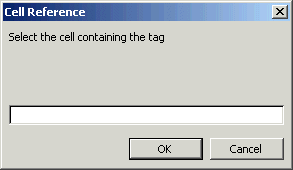
Tag Enter or browse to the item for which you want to retrieve historical data,
for example, FIC101.PV. Alternatively, use the cell reference selector button to
open the Cell Reference dialog. On that dialog you can click on a cell in any
Excel workbook that contains the tag. You can also type the
cell reference (such
as A1 or $A$1) that contains the tag in the current workbook. Another method is
to use a defined name (such as MyTag) that is already configured in the workbook.
For more information about cell references and defined names, refer to the Microsoft Excel
online help.
-
Period Defines the overall time period and the subintervals for
the analysis. You specify the overall time period using the From and To group boxes.
The results obtained by the worksheet function will be in the time order used
here, so if you want the latest data to appear first in your worksheet,
specify the latest time in the From group box and the earliest time in the To
group box.
The Mode and Offset controls tell the Continuous Historian server how
to interpret the times you specify.
-
Mode Select the mode for the start and end timestamps: Local Time or GMT.
If GMT, you can specify an offset in hours and minutes. If local, the timestamp is treated as being in the
time zone of the client PC.
-
Offset If GMT is selected as the mode, you can select a time offset in +/-hh:mm.
From Defines the start of the time period.
-
Date/Time The timestamp of the start of
the period you wish to examine. This allows selection of date/times with precision of 1 second.
-
Cell Reference If the timestamp is a cell reference, the
contents of the referenced cell must be a timestamp. (This allows selection of
times in Excel standard format with
millisecond precision,
although it should be noted that the Continuous Historian records data on quarter-second
boundaries: .000, .250, .500, .750.)
To Defines the end of the time period.
-
Date/Time The timestamp of the end of
the period you wish to examine. This allows selection of date/times with precision of 1 second.
-
Cell Reference If the timestamp is a cell reference, the
contents of the referenced cell must be a timestamp. (This allows selection of
times in Excel standard format with
millisecond precision, although it should be noted that the Continuous Historian records data on quarter-second
boundaries: .000, .250, .500, .750.)
Intervals Defines the intervals for the samples to be
retrieved.
-
Interval The duration of each interval. Enter
a positive number followed by a unit string, selected from the dropdown list.
The dialog warns if the overall time period is not an exact multiple of this
interval. This would lead to a final interval that is smaller than the others.
If this situation is allowed to stand, the worksheet function will extend the
overall period by adjusting the To date.
-
Number of Intervals The number of intervals
for which you want data. By configuring this value, the dialog
automatically calculates the interval duration based on the currently specified
start and end times. If the number is capped, the background color of the
control turns from gray to yellow to indicate that capping has occurred.
-
For more information
about the maximum boundaries of a worksheet, refer
to Use the Worksheet Functions.
Display Data Allows you to specify the requested data to be
shown in the worksheet function results.
-
Header Row (check box) Indicates
whether you want the returned data to include a header row that contains
standard headers for each column. The text will be specific to the data in the
column and any attributes you choose. If you require different column headings,
clear this check box and enter the headings you require directly into the
worksheet.
-
Columns Defines the columns
that will be included in the tabular results of the worksheet function. Each
column definition is made up of the column name and, optionally, various
attributes relating to that specific column.
Available columns To add a column, select the column name and
click the right arrow button. The standard Windows Shift and Control keys
can be used to select multiple columns. Note that you can add a column to
the results more than once; you might do this to see the column with different
attributes, for example, a timestamp in GMT and the same timestamp in Local
time.
-
Selected columns To remove a Selected column,
click the column name and click the left arrow button. The Up and Down arrow
buttons can be used to rearrange the order of the columns.
-
Attributes For the selected column, click
Attributes to view the parameter attributes in a separate dialog box. Select the attribute by clicking
a radio button or choosing the attribute from a drop-down list. The Attributes
button is disabled if multiple columns are selected in the Selected Columns
list, or if the selected column does not support attributes.
Worksheet Use this section of the dialog to set up what will be
an array formula in the worksheet. You can select a rectangular region of the
correct size before invoking the dialog. Or you can use the "Adjust selection to accommodate results (if necessary)" check box together with the
"Insert rows and columns" check box. For more information about array
formulas,
refer to the Microsoft Excel online help.
-
Required Range Displays the dimensions of the array that will be
yielded based on the current selections in the dialog fields.
-
Current Range This field displays the current selected range and
the dimensions of that range. If
this range is smaller than the Required Range, then data will be truncated in the
workbook, unless "Adjust selection to accommodate results" is used (see below).
-
Adjust selection to accommodate results (if necessary) If the
Required Range is larger or smaller than the Current Range, use this check box (and the
"Insert rows and columns" check box if necessary) to
cause the dialog to adjust the current range when the OK button is clicked.
-
Insert rows and columns Use this
check box (in combination with the "Adjust selection to accommodate results" check
box) to set up a rectangular region of cells that will contain the results. Use
this check box if the worksheet contains additional data below or to the right of
the selected cell; otherwise, that data may be overwritten.
-
Extra row(s) This can be used to expand the
selection beyond the current number of rows even without using the Try It feature.
Select the check box and specify the number of rows to be added. This feature
might be useful where there is a possibility that the time period could cross a
daylight savings boundary. For example, a shift report gathering data every 30
minutes for what is normally an 8-hour shift, could yield 9 hours worth of data
if the clocks change during the shift. By inserting two extra rows, there would
be space for the additional data.
Try It Button Opens a grid view in which the results can
be previewed. This dialog will show the real results from querying the
Continuous Historian database. The Try It window shows the row and column at
which the data will be inserted. (Thus, if the formula is inserted at B7, the
Try It grid starts at B7.) The Try It window can be closed at any
time to abort a query that is taking too long to complete.
OK Button Accepts your changes and closes the dialog. A tooltip
for the OK button shows the formula that will be inserted when the OK button is clicked.
Note that until all fields in the dialog are completed with valid values, the OK
button is disabled. If a cell reference is used, the OK button is disabled if
the referenced cell does not contain a valid value (for example, the referenced
cell is blank or contains a tag name as the value for a Date/Time field). If
the OK button is disabled, a warning icon appears on the OK button; a tooltip for the
warning icon provides further information.
Cancel Button Closes this dialog without accepting the changes.