Use this dialog to configure a worksheet function to retrieve a total count of filtered events from the Event Chronicle database for one or more shifts within a time period. The Event Count function counts Event Chronicle events from the active and all current event history data sets. To prevent duplication of events, it does not count events in the active data set that have been copied to a current data set, but have not yet been deleted from the active data set. The single value returned can include events filtered according to the following criteria:
For more information about the Configure Event Count Function dialog, refer to Worksheet Function Reference in Books Online.
The dialog contains the following areas:
Chronicle Node Enter or browse to the connection string for accessing the Event Chronicle database. This is the node name of the Event Chronicle server.
Period(s) Defines the overall time period for the analysis.
The Mode and Offset controls tell the Event Chronicle server how to interpret the times you specify.
Mode Select the mode for the start and end event timestamps: Local Time or GMT. If GMT, you can specify an offset in hours and minutes. If local, the timestamp is treated as being in the time zone of the client PC.
Offset If GMT is selected as the mode, you can select a time offset in +/-hh:mm.
From Defines the start of the time period.
Date/Time The timestamp of the start of the period you wish to examine. This allows selection of date/times with precision of 1 second.
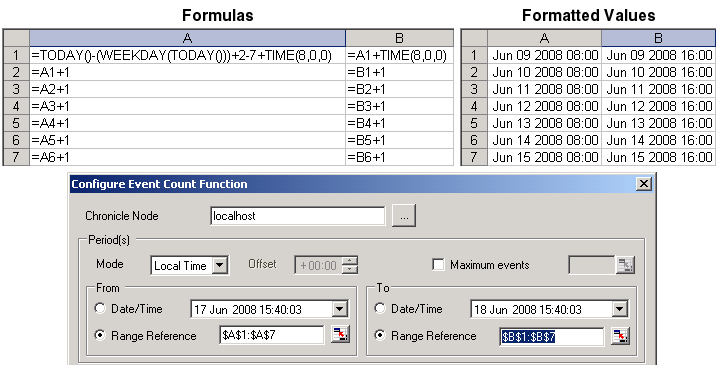
Range Reference By entering timestamps in a range of worksheet cells, you can specify a series of start and end-time pairs with cell references. In this way, you can specify timestamps in standard Excel format, up to millisecond precision, to define scenarios such as, “events from the 8:00 a.m. to 4:00 p.m. shift for last week.” The picture under Example below illustrates how you could enter formulas into a series of cells to define this scenario, and then specify $A$1:$A$7 as the start time as a Range Reference.
Note If the start time of the specified time period is later than the end time of the specified time period, events are retrieved in reverse chronological order from the (later) start time toward the (earlier) end time.
To Defines the end of the time period.
Date/Time The timestamp of the end of the period you wish to examine. This allows selection of date/times with precision of 1 second.
Range Reference By entering timestamps in a range of worksheet cells, you can specify a series of start and end-time pairs. In this way, you can specify timestamps in standard Excel format, up to millisecond precision, to define scenarios such as, “events from the 8:00 a.m. to 4:00 p.m. shift for last week.” The picture under Example below illustrates how you could enter formulas into a series of cells to define this scenario, and then specify $B$1:$B$7 as the end time as a Range Reference.
Example
Filtering Allows you to specify the events to be counted for single value returned in the worksheet function results.
Available Filter Columns To add a column, select the column name and click the right arrow button. The standard Windows Shift and Control keys can be used to select multiple columns. Note that you can add a column to the results only once.
Selected Filter Columns To remove a Selected column, select the column name, and then click the left arrow button. The Up and Down arrow buttons can be used to rearrange the order of the columns.
Filters You must select each item in the Selected Filter Columns list, and then click Filters to open the Filter Settings dialog box to specify filters either by selecting from a Browse List of available filters or by specifying a text string, including wildcard patterns, to define a filter setting.
Try It Button Opens a grid view in which the results can be previewed. This dialog will show the real results from querying the Event Chronicle database. The Try It window shows the row and column at which the data will be inserted. (Thus, if the formula is inserted at B7, the Try It grid starts at B7.) The Try It window can be closed at any time to abort a query that is taking too long to complete.
Note Because the Event Count function returns a single value, the Try It window previews only one cell when used with this function.
OK Button Accepts your changes and closes the dialog. A tooltip for the OK button shows the formula that will be inserted when the OK button is clicked. Note that until all fields in the dialog are completed with valid values, the OK button is disabled. If a cell reference is used, the OK button is disabled if the referenced cell does not contain a valid value (for example, the referenced cell is blank or contains a date/time value for the Maximum events field). If the OK button is disabled, a warning icon appears on the OK button; a tooltip for the warning icon provides further information.
Cancel Button Closes this dialog without accepting the changes.