Equipment arbitration in phase logic
If you need a resource for a small portion of a phase, you can acquire and release the unit in the phase logic rather than configure the equipment as a needed resource. The benefit of programming equipment requests in the phase logic is that you can release the resource prior to the completion of the phase, making it available to other requesters. Otherwise, the resource is owned by the phase for the entire execution of the phase.
 CAUTION
Setting Maximum Owners on unit phases and phase logic modules to any value greater than 1 is strongly discouraged as a phase cannot be successfully run by multiple owners at the same time.
Maximum Owners on a unit allows different phases to own the same unit and run on that unit simultaneously.
For example, if two mixers share the same valve, you need to assign the valve as a needed resource to each unit. Furthermore, if the valve can only be used by one unit at one time, you need to set the maximum owners to one.
With this configuration, the valve is acquired by the first unit procedure to send a request for the valve. When the unit procedure completes, the valve is released and can be acquired by another unit procedure.
In the phase logic, write an expression that references the unit parameter (of the type parameter reference) to read process data associated with that unit. Unit parameters are used in recipe transitions, which define when a recipe moves from one step to another. For example, you may want to verify that the level of a mixer reaches a specific value before allowing the recipe to continue to the next step. The unit parameter for tank level is referenced in the phase logic for the phase requiring the specific level value.
The unit parameters are created at the unit class level and are instantiated when a unit module is created in an area. The specific reference is defined at the unit module level for the unit parameter.
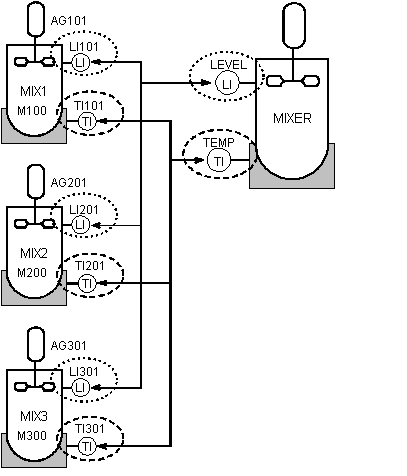
In the example illustrated in the following figure, the MIXER class of units in the sample paint application contains two class-based parameters: LEVEL and TEMP. These are variable names for the specific unit parameters defined on each instance of the unit.
Unit Parameters Used in Phase Control