And sequence selections
An And sequence selection defines the logic for parallel processing. Use this sequence selection when you need two or more steps to run in parallel.
Create all branching and looping after the second step. This allows the recipe to be put into manual mode before the loop or branch begins, permitting an Active Step Change. With an Active Step Change, you must put the step preceding the one you want to control into manual mode. Since the first step in a recipe is a placeholder, it cannot be put into manual mode. If the second step is where the loop or branch begins, you can never perform an Active Step Change on that loop or branch. Therefore, begin the loop or branch at the third step. The second step can then be put into manual mode when needed for control of the anteceding step.
The And sequence selection defines a Boolean condition. This condition must be true for the steps that follow it to execute. If part of the condition is true and part is false, the recipe waits until the entire condition is true.
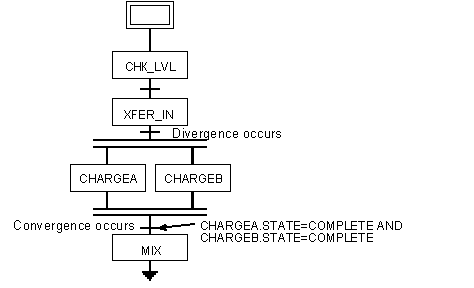
For example, suppose a unit procedure needs to charge two vessels at the same time during production. You do not want to move on to the next step (which mixes the contents of the two vessels) until both vessels contain the correct amount of material.
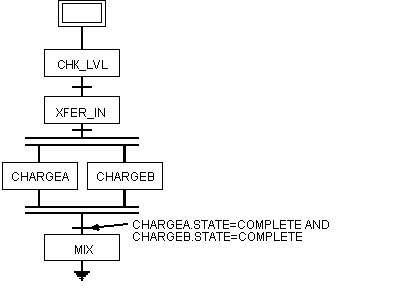
Using an And sequence selection in the operation lets you set up the required logic. This is done by placing a transition after the two CHARGE steps. When the operation runs, the MIX step does not execute until both CHARGE steps are complete.
Using an And Sequence Selection
And Convergence and Divergence
You can create two types of And sequence selections: a divergence and a convergence. A divergent And connects one transition to two steps. A convergent And connects two steps to one transition.
And Convergence and Divergence Example