Process model
The process model is a result of performing procedural control on the equipment in the process. The procedural control model, when mapped to the equipment, provides the processing functions described in the process model.
The relationships between the procedural control model and the four lower levels of the physical model to produce the process model are shown in the following figure.
Process, Procedural Control, and Physical Model Relationships
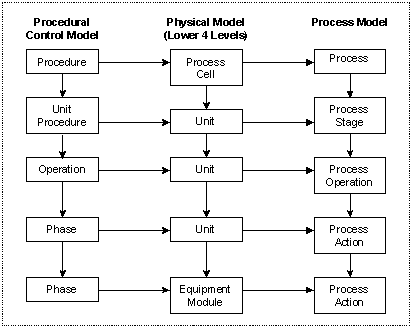
The process model consists of the following levels:
-
Process - the production of a batch using the available equipment. A process consists of a procedure run on a process cell.
-
Process Stage - a set of process operations. A process stage results from performing a unit procedure on an equipment unit. A specific set of operation instructions is included in the unit procedure. When a unit is allocated for a particular batch, it executes the instructions using any additional parameters passed to it at execution time.
-
Process Operation - a set of process actions. A process operation typically transforms material from one state to another. It can be achieved by running an operation on a unit.
-
Process Action - a minor processing task. This is the lowest level of processing activity within the process model. When combined, multiple process actions comprise a process operation. A process action can be achieved by running a phase on a unit.