Using output function blocks with the DVC6000ESD
The LSDVC function block provides an interface to the DVC6000ESD for safety shutdown and for partial stroke testing. The HART Two-state Output channel or CHARM provides the control signal and the HART communications path to the digital valve controller. You can configure the output to have an OFF_CURRENT of 0 mA or 4 mA. The control signal can command the valve controller to the tripped state regardless of the configured OFF_CURRENT value. Using an OFF_CURRENT value of 4 mA allows HART communication between the logic solver and the valve controller whether the valve controller is in the normal or the trip state. When the OFF_CURRENT is 0 mA, the power is removed entirely when the LSDVC function block drives the channel or CHARM Off.
 CAUTION!
It is recommended to keep the travel cutoffs in the DVC6000ESD (Travel Cutoff High and Travel Cutoff Low) at their default value of 50%. Do not set Travel Cutoff Low below 15% or set Travel Cutoff High above 85%.
Implementation Example
-
Outfit the valve with a solenoid as shown in the figure below.
-
Use two output channels or CHARMs, one configured as Discrete Output and one as HART Two-state Output.
-
Set the OFF_CURRENT parameter to 4 mA.
-
Use two output function blocks in the SIS module, one LSDO and one LSDVC.
-
Wire the EFFECTn output from the LSCEM function block to the CAS_IN_D input on both function blocks.
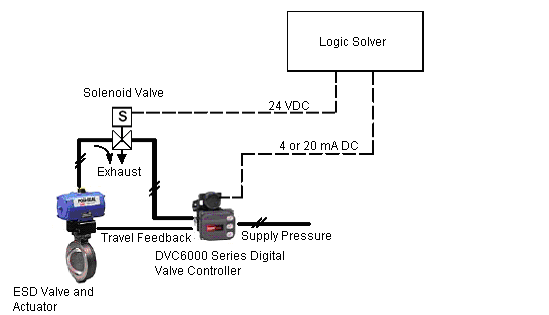
An advantage of this implementation is HART communication is active whether the valve is in the normal or trip state.
Alternate implementation
-
The DVC6000ESD is not outfitted with a solenoid valve.
-
Use a single output channel or CHARM configured as HART Two-state Output.
-
Set the OFF_CURRENT parameter to 0 mA.
-
Use one output function block, an LSDVC block, in the SIS module
-
Wire the EFFECTn output from the LSCEM function block to the CAS_IN_D input of the LSDVC function block.
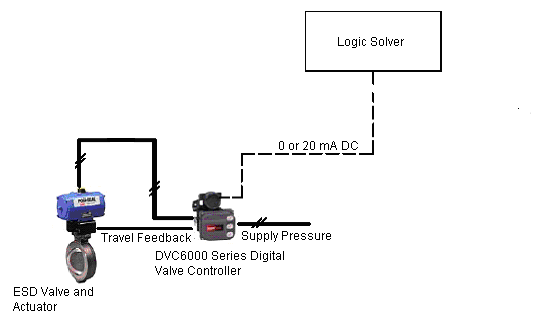
An advantage of this implementation is that only one output channel or CHARM is required. The disadvantage is not having HART communication when the DVC6000ESD is in the shutdown state.