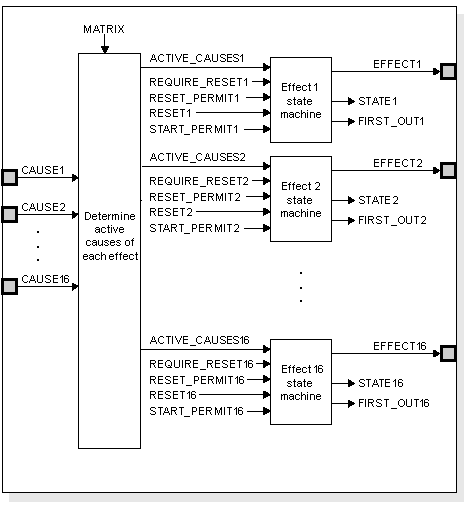
Use the LSCEM function block to define interlock and permissive logic that associates as many as 16 inputs (CAUSEn parameters) and 16 outputs (EFFECTn parameters). Use the block's MATRIX parameter to identify one or more causes that cause each effect to trip. When a CAUSEn becomes active, all effects associated with that CAUSEn also trip.
 CAUTION!
Avoid renaming any LSCEM block in a running system. If you do rename the block, for all REQUIRE_RESETn that are True, the block's corresponding EFFECTn output will be de-energized when the block is downloaded.
The LSCEM block does not support modes.
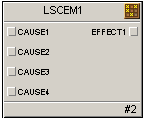
An LSCEM block provides the logic for one or more safety instrumented functions (SIF). CAUSEn inputs are typically wired from upstream voter function blocks, but may come from any source indicating either an active (0) or inactive (1) process trip condition. The EFFECTn outputs are typically wired to downstream output function blocks.
Because the Logic Solver is a de-energize to trip environment the Normal operating value of EFFECTn parameters is 1 and the Tripped value is 0.
By default, the block has four CAUSEn inputs and one EFFECTn output. You can set the number of causes and effect using the NOF_CAUSES and NOF_EFFECTS extensible parameters. In addition, you can use the DESC_CAUSEn and DESC_EFFECTn parameters to label causes and effects.
The following diagram shows the internal components of the LSCEM function block.