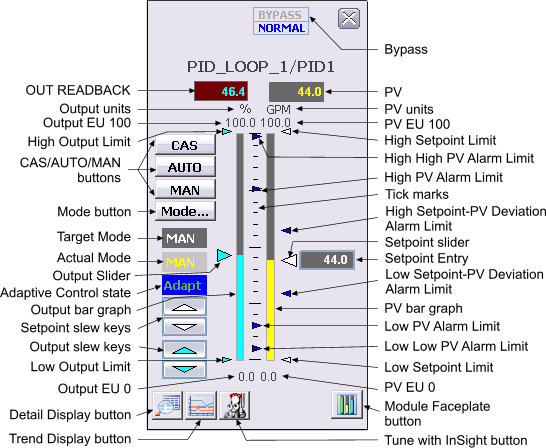
The following items are contained in the PID function block faceplate:
-
Bypass - This area is visible if the Bypass Enable option is set in CONTROL_OPTS (typically when the PID block is a slave in a cascade pair). Bypass makes the output value equal to the % SP value, which allows the master loop to drive the output if the transmitter is unavailable. When the block is in MAN or OOS mode, click Bypass to turn Bypass on. Click Normal to turn off Bypass.
-
Tag name - Tag name of module that uses this faceplate.
-
OUT_READBACK - This area displays the OUT_READBACK value of the PID block in cyan. The background color of the 3-D box changes from gray to orange or red when the Output status becomes uncertain or bad, respectively. In the absence of a configured IO_READBACK DST, the OUT_READBACK value shown is equal to the implied output value of the loop. The displayed decimal format of OUT_READBACK is determined by the OUT_SCALE.DECPT parameter field.
Clicking this box while the target mode of the block is MAN or OOS produces a dialog prompting the operator for an Output value. The valid range for input is defined by the EU 0 and EU 100 values of the OUT_SCALE parameter. Valid input ranges from -10 percent to 110 percent of OUT_SCALE.
-
PV - This area displays the PV value of the PID block in yellow. The background color of the 3-D box changes from gray to orange or red when the PV status becomes uncertain or bad, respectively. The PV value is visible in the decimal format provided by PV_SCALE.DECPT.
-
Output Units - This is the engineering units description for the Output as defined in the OUT_SCALE parameter.
-
PV Units - This is the engineering units description for the PV as defined in the PV_SCALE parameter.
-
Output EU 100 - This is the value corresponding to 100% of scale for the Output.
-
PV EU 100 - This is the value corresponding to 100% of scale for the PV.
-
CAS/AUTO/MAN buttons - These buttons are used to set the target mode of the PID block to the corresponding mode. The visibility of these three buttons is based on permitted modes of the PID block. Buttons for CAS, AUTO, and MAN mode are displayed when the respective mode is a permitted mode.
-
Mode button - This button is used to display a list of the target modes available for the block. Click one of the permitted modes to set the block target mode to that mode. To close the mode selector box, click the X button.
-
Target Mode - This field contains a word in white text that describes the target mode for the loop. The background changes to blue when the target mode and normal mode are different.
-
Actual Mode - This field contains a word in yellow text that describes the ACTUAL mode of the loop. The background changes to blue when the actual mode and normal mode are different.
-
Adaptive Control state - This field indicates that an Adapt license has been assigned to the block and the actual Adapt mode is not Off or the target Adapt mode is not Off. The background changes to blue when the actual and target modes are different.
-
Setpoint slew keys - These gray buttons with a white arrowhead pointing up or down are used to increment or decrement the setpoint value by 1 PV engineering unit if PV_SCALE.F_DECPT is less than or equal to 1. If PV_SCALE.F_DECPT is 2 or greater, each click changes the setpoint by 0.1 engineering unit. The setpoint slew keys are visible if the target mode is AUTO, MAN, or OOS.
-
Output slew keys - These gray buttons with a cyan arrowhead pointing up or down are displayed below the Setpoint Slew keys only when the loop has a target mode of MAN or OOS. Click the up arrow or down arrow to increment or decrement the Output value by 1 Output engineering unit.
-
Output bar graph - This field indicates the value of OUT_READBACK, which is the same as the value displayed in the OUT_READBACK display box.
-
Output slider - This large cyan arrowhead to the left of the Output bar graph is displayed only when the target mode of the block is MAN or OOS. To move this button, hold down the left mouse button while the cursor is over the arrowhead and then move the mouse up or down to correspond to the new Output value desired. The new value is then written to the Output parameter of the loop. The arrowhead remains in the new position.
-
Output Limits - These cyan arrowheads are vertically positioned relative to the OUT_READBACK bar graph to indicate the High and Low Output Limits. Although these arrows cannot be dragged with the mouse, the values they indicate can be modified by using the block's detail display.
-
Tick marks - This vertical arrangement of black lines is used to indicate percentages of PV and Output scale.
-
PV bar graph - This graph indicates the value of the PV parameter for the block, which is the same as the value displayed in the PV display box.
-
Setpoint slider/Working Setpoint - To move the Setpoint slider, hold down the left mouse button with the cursor over the arrowhead and then move the mouse up or down to correspond to the new SP (setpoint) value desired. The new value is then written to the SP parameter of the loop. The arrowhead is controllable only when the actual mode is AUTO, MAN, or OOS.
Another arrowhead (not displayed in the above figure) with the same size and movement range as the Setpoint slider but with a transparent fill color and a black border indicates the Working Setpoint (SP_WRK) of the block. This arrow's movement range is restricted within the Setpoint Limit arrows and is the actual SP used by the controller to calculate output moves. When SP and SP_WRK have the same value, SP_WRK is superimposed upon SP and, therefore, is not distinguishable from SP. The Working Setpoint is visible as a separate entity when setpoint ramping prevents SP_WRK from going to SP immediately.
-
Setpoint Entry - Setpoint Entry is the 3-D recessed box displaying the SP value of the block. The Setpoint Entry box is next to the Setpoint slider. The background color of this box changes from gray to orange or red when the PV status becomes uncertain or bad, respectively. Clicking this box produces a dialog box that prompts you for an SP (setpoint) value. A setpoint change is accepted while the actual mode is AUTO, MAN, or OOS. The valid range for input is defined by the engineering unit EU 0 and EU 100 values of PV_SCALE. Valid input ranges from 0 to 100 percent of PV_SCALE. The SP value is then visible in the decimal format provided by PV_SCALE.DECPT.
-
Setpoint Limits - These white arrowheads are vertically positioned relative to the PV bar graph to indicate the High and Low SP Limits. Although these arrows cannot be dragged with the mouse, the values they indicate can be modified using the block's detail display.
-
Deviation Alarm Limits - These blue arrowheads are vertically positioned relative to the Setpoint slider to indicate the High and Low SP-PV Deviation Alarm Limits. Although these arrows cannot be dragged with the mouse, the values they indicate can be modified using the module's detail display.
-
PV Alarm Limits - These blue arrowheads are vertically positioned relative to the PV bar graph to indicate the High High, High, Low, and Low Low Alarm Limits for the PV. Although these arrows cannot be dragged with the mouse, the values they indicate can be modified using the block's detail display.
-
Output EU 0 - This area shows the value corresponding to 0% of scale for the Output.
-
PV EU 0 - This area shows the value corresponding to 0% of scale for the PV.
-
Detail Display button - This button is used to open the detail display for the PID block.
-
Trend Display button - This button is used to open the trend display for the PID block. A trend display is a popup picture that shows a one second trend trace for each of the module's main operating parameters. The trend traces start when the picture is opened and stops when it is closed.
-
Tune with InSight button - Press this button to start DeltaV InSight in the context of this block.
-
Module Faceplate button - This button is used to open the module faceplate display.