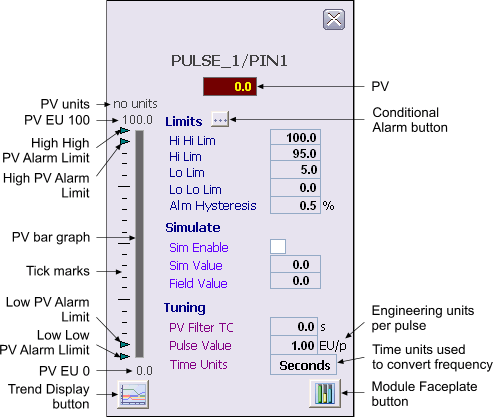
The following items are contained in the Pulse Input function block faceplate:
-
Conditional Alarm button – Available when conditional alarming is enabled. Displays a popup with the conditional alarming parameters. Change the values of these parameters using the Conditional Alarm popup.
-
PV – This area displays the PV value of the AI block in yellow. The background color of the 3-D box changes from gray to orange or red when the PV status becomes uncertain or bad, respectively. The PV value is visible in the decimal format provided by PV_SCALE.DECPT.
-
PV Units – This is the engineering units description used for the PV as defined in the OUT_SCALE parameter.
-
PV EU 100 – This is the value corresponding to 100% of scale for the PV.
-
Tick marks – This vertical arrangement of black lines indicates percentages of Output scale.
-
PV bar graph – This graph indicates the value of the PV parameter for the AI, which is the same as the value displayed in the PV display box.
-
PV Alarm Limits – These blue arrowheads are vertically positioned relative to the PV bar graph to indicate the High High, High, Low, and Low Low Alarm Limits for the PV. Although these arrows cannot be dragged with the mouse, the values they indicate can be modified by using the block's detail display.
-
PV EU 0 – This area shows the value corresponding to 0% of scale for the PV.
-
Trend Display button – This button is used to open the trend display for the AI block. A trend display is a popup picture that shows a one second trend trace for each of the module's main operating parameters. The trend traces start when the picture is opened and stop when it is closed.
-
Module Faceplate button - This button is used to open the module faceplate display.
-
Limits:
-
Hi Hi Lim – This area displays the maximum value of the PV in engineering units before the High High Limit active bit (HI_HI_ACT) is set. Click this field to enter a new limit.
-
Hi Lim – This area displays the maximum value of the PV in engineering units before the High Limit active bit (HI_ACT) is set. Click this field to enter a new limit.
-
Lo Lim – This area displays the minimum value of the PV in engineering units before the Low Limit active bit (LO_ACT) is set. Click this field to enter a new limit.
-
Lo Lo Lim – This area displays the minimum value of the PV in engineering units before the Low Low Limit active bit (LO_LO_ACT) is set. Click this field to enter a new limit.
-
Alm Hysteresis – This area displays the alarm hysteresis (or deadband) value for the alarm conditions in % of Out scale. Click the value to enter a new value. An alarm condition does not recur until the PV has backed away from the corresponding limit by at least the % of Out Scale specified by this value.
-
-
Simulate:
-
Sim Enable – This box is used to enable or disable the simulate value as input to the AI. When the check box is checked, the simulate value is used to calculate the PV value.
-
Sim Value – This area simulates the field value. When simulate is enabled, you can scale the sim value using the Out scale to calculate the PV value. Click this field to enter a new limit.
-
Field Value – This field indicates the raw field value. You can scale this value using the Out scale to calculate the PV value when simulate is disabled.
-
-
Tuning:
-
PV Filter TC – This field indicates the PV filter time constant in seconds. Click this field to enter a new value.
-
Pulse Value – Click this field to enter the number of engineering units per pulse.
-
Time Units – This field indicates the units of time used to convert frequency: Seconds, Minutes, Hours, or Days.
-