The Bias/Gain function block is often used as a slave to a Splitter function block which is, in turn, a slave to the master controller in a control algorithm. The following diagram shows a typical example:
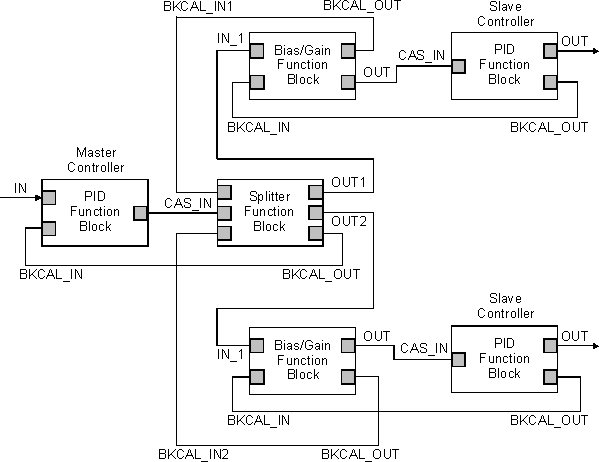
The master controller OUT parameter determines the setpoints of two slave PID blocks through a splitter and two BIAS/GAIN blocks. The Bias/Gain blocks allow each setpoint to be modified so that parallel field devices (for example, valves, pumps, fans) can be properly synchronized to the demands of a single master. Suppose the two slave PIDs control the speed of two variable-speed fans supplying a furnace. In this situation, the master controller monitors the total air demand and its OUT sets the total demand. The BIAS/GAIN blocks provide the means to apply more or less of the demanded control action through one or the other of the fans (by SP or GAIN adjustment).
In this example, you must enable the Use BKCAL_OUT With IN_1 option in the properties for the CONTROL_OPTS parameter of both Bias/Gain function blocks.