You can use the Condition function block to implement complex calculations, signal conditioning, or functionality that is not available in the standard function blocks. You can use trigonometric, exponential, and power functions, as well as standard mathematical operations.
You can also use a group of Condition function blocks to evaluate multiple conditions and to send the outputs to other logical function blocks, such as the And, Or, or Boolean Fan Input (BFI) function blocks.
Application example: monitor exothermic runaway
Assume you have a chemical reactor that combines ingredients for an exothermic reaction. The process must be monitored for the presence of a runaway exothermic reaction. When one occurs, the flushing system must start up automatically to bring the reaction under control. The following figure shows an example of this process:
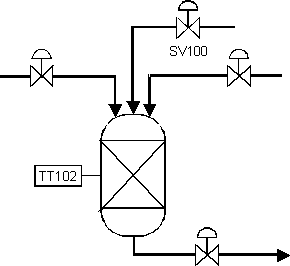
Assume the reaction is considered a runaway when the temperature is greater than 400 °F for longer than five minutes. When this condition occurs, the SV100 valve must be opened to allow operation of the flushing system. You use a Condition function block to monitor for this condition and to send a signal to start the flushing operation. The following figure is the function block diagram for this example:
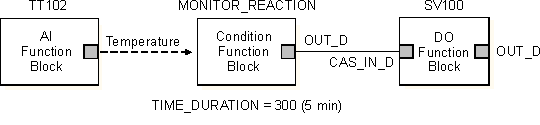
When the temperature exceeds 400°F, the condition evaluates as True (1). When the condition remains True for more than 5 minutes (300 sec), OUT_D is set True. This signals the DO function block to open the SV100 valve and begin the flushing operation. You configure the following expression in the Condition function block for this application:
REM Return True when reaction temperature is greater than 400
REM degrees, otherwise return False
'/TT102/PV.CV' > 400.0
When the reaction is slowed and the temperature drops below 400 °F, the condition evaluates as False (0) and OUT_D is False. This signals the DO function block to shut the flushing system valve.