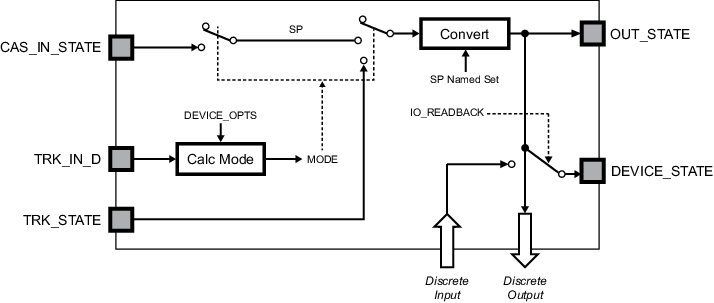
The Smart HART Discrete Output (SHDO) function block takes a setpoint SP (such as OPEN or CLOSE from a configured named set), converts it to its corresponding numeric value based on Named set codes for SMART HART SHDI and SHDO blocks, and writes that value to the channel specified in IO_OUT. Wireless devices must receive numeric values corresponding to those in the named set codes. Confirm that devices respond correctly using DEVICE_STATE, which contains a string from the named set corresponding to the numeric value read back from the devices if channel readback is enabled. If readback is not enabled DEVICE_STATE is the string value of OUT_STATE.
The Smart HART Discrete Output function block supports mode control and output tracking.
If the block is in Cascade (CAS) mode, a signal from another block can change the setpoint. Change to Automatic (Auto) mode to disconnect the other block and to set the setpoint locally. If TRK_IN_D becomes true, the block goes into Local Override mode, and OUT_STATE begins tracking the value of TRACK_STATE. Enable the DEVICE_OPTS option SP Track on Tracking to avoid process bumps when tracking ends.
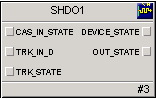
CAS_IN_STATE is the named set value wired in from another block.
TRK_IN_D is the discrete input that initiates the external tracking function.
TRK_STATE is the Named Set value applied to OUT_STATE in Local Override (LO) mode.
OUT_STATE is the Named Set value and status going to a Discrete Output variable.
DEVICE_STATE is the string corresponding to the block's PV.
The following diagram shows the internal components of the Discrete Output function block: