The AGA_US function block is one of two flow metering function blocks on the Energy Metering palette. It is designed to calculate the flow of natural gas through orifice and turbine meters, but can be used for other gases and liquids (virtually any single phase, Newtonian fluid under turbulent flow).
The AGA_US function block is identical to the AGA_SI block, except for the engineering units used. Each applicable parameter in the AGA_US block has a particular U.S. engineering unit. If input or output parameters require other engineering units, conversion should be done upstream or downstream of the block. The other flow metering block, AGA_SI, uses SI (System International) units.
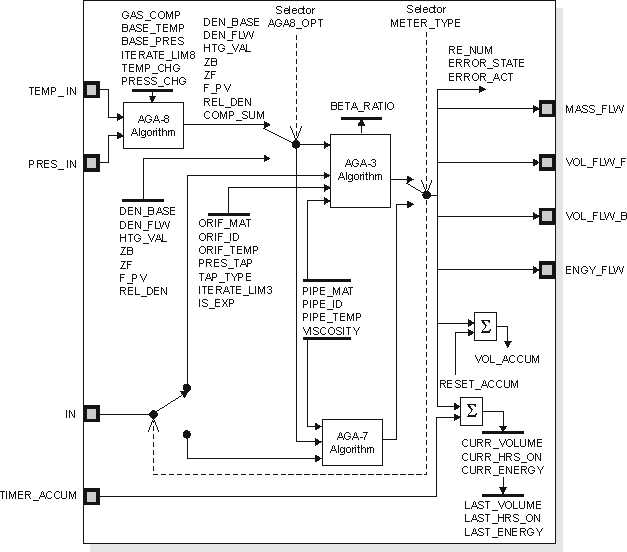
The AGA_US block calculates instantaneous mass flow, volumetric flow, and energy flow for natural gas using equations defined in AGA (American Gas Association) reports and ISO standards.
-
Mass flow calculation for orifice metering per AGA3/1995
-
Limits of use for orifice metering per AGA3/1995
-
Calculation of densities and compressibility factors per AGA8/1994 (detail characterization method)
-
Turbine metering calculations per AGA7/1996
-
Calculation of gas heating value per ISO6976/1999 (real gas superior calorific value using 15/15 data)
The block calculates density for natural gases and other related hydrocarbon gases. For other fluids the density can be entered manually.
In addition to calculating instantaneous flow rates the block provides totalization parameters for base volumetric flow and energy flow that can be reset.
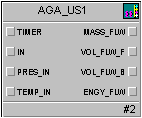
IN is the differential pressure (orifice meter) in inH2O at 68°F or volumetric flow from a PIN function block (turbine meter) in ft3/hr.
PRES_IN is the static pressure in psia.
TEMP_IN is the fluid temperature in °F.
TIMER_ACCUM is the input to reset totalization parameters typically wired from OUT_D of a DTE (Date Time Event) function block.
MASS_FLW is the instantaneous mass flow rate in lb/hr.
VOL_FLW_F is the volumetric flow rate at flowing conditions in ft3/hr.
VOL_FLW_B is the volumetric flow rate at base conditions in ft3/hr.
ENGY_FLW is the energy flow in MMBTU/hr.
The ranges of valid block input values mentioned in this section are guidelines, not absolute limits. If your inputs are outside the guidelines, block calculations lose accuracy, losing more accuracy the farther you are outside the guidelines.
The following figure shows the internal components of the AGA function block: