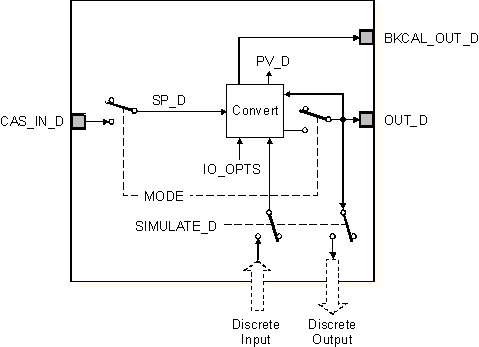
The Discrete Output (DO) function block takes a setpoint and writes it to a specified I/O channel to produce an output signal. You can confirm the physical output operation by configuring a hardware discrete input, which produces a value that should match the setpoint.
The Discrete Output function block supports mode control, output tracking, and simulation. There are no standard alarms in this function block. Custom alarms are supported.
Normally, the block is used in Cascade (Cas) mode so a signal from another block changes the setpoint. You change to Automatic (Auto) mode to disconnect the other block and to set the setpoint locally. The other block tests the status of the Discrete Output function block through the BKCAL_OUT_D output.
To support testing, the block uses a simulation switch to indicate Good block status even when there is no hardware connected.
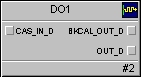
CAS_IN_D is the remote setpoint value from another function block.
BKCAL_OUT_D is the discrete output value and status required by the BKCAL_IN_D input of another block for output tracking.
OUT_D is the discrete output value and status.
The following diagram shows the internal components of the Discrete Output function block: