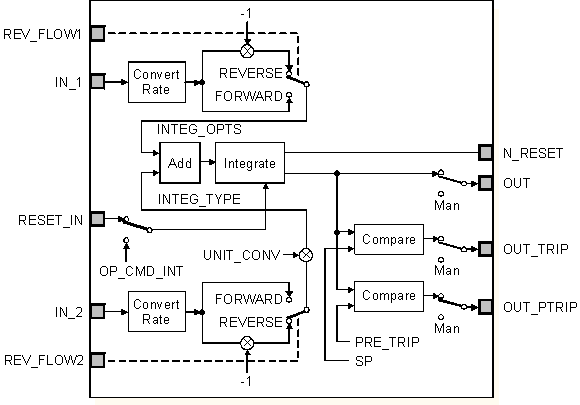
The Integrator (INT) function block integrates one variable or the sum or difference between two variables over time. The block compares the integrated or accumulated value to pre-trip and trip limits and generates discrete output signals when the limits are reached. This function block can also be used as a totalizer.
You select one of seven integrator types that determine whether the integrated value increases from 0 or decreases from the setpoint (SP). The block has two inputs and can integrate positive, negative, or net flow. This capability is useful to calculate volume or mass variation in vessels or as an optimization tool for flow ratio control.
The Integrator function block supports mode control, demand reset, a reset counter, and signal status calculation. There are no standard alarms in this function block. Custom alarms are supported.
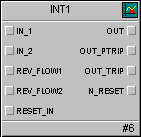
IN_1 is the first input value and status. Specify the rate time base for IN_1 with TIME_UNIT1.
IN_2 is the second input value and status. Specify the rate time base for IN_2 with TIME_UNIT2.
REV_FLOW1 is the discrete input that specifies whether IN_1 is positive or negative.
REV_FLOW2 is the discrete input that specifies whether IN_2 is positive or negative.
RESET_IN is the discrete input that resets the integrator and holds reset until released.
OUT is the integration output value and status. When the integration type counts up (0 to SP), OUT equals the value of the internal accumulator register TOTAL. When the integration type counts down (SP to 0), OUT equals SP – TOTAL .
OUT_PTRIP is a discrete value that is set when the pre-trip limit value is reached. OUT_PTRIP remains latched until OUT_TRIP latches, then OUT_PTRIP unlatches.
OUT_TRIP is a discrete value that is set when the trip target value is reached. OUT_TRIP latches for five seconds or one scan (whichever is greater), then unlatches.
N_RESET is the number of times the integrator is initialized or reset.
The following figure shows the internal components of the Integrator function block: