The Splitter (SPLTR) function block takes a single input and calculates two outputs based on specified coordinate values. This allows an integrating controller to drive two outputs without winding up when either or both outputs are constrained.
The Splitter function block supports mode control and signal status propagation. There are no standard alarms in this function block. Custom alarms are supported.
The transfer function for each output is a straight slope described by its endpoints. The control regions defined by the slopes can be separate or can overlap, but the low input limit is determined by the first output (OUT_1) and the high input limit is determined by the second output (OUT_2).
The block's normal mode is Cascade (Cas). You can isolate the block for testing by using Automatic (Auto) mode and adjusting the setpoint. Manual (Man) is not a permitted mode.
When another block attached to a splitter block output is switched to Cas mode, one of the following actions occurs:
-
When the block associated with the other splitter block output is not in Cas mode, the block attached to the splitter block input is initialized so that bumpless transfer is provided and control action begins at the current value of the block switched to Cas mode.
-
When the block associated with the other splitter block output is in Cas mode, the output to the block switched to Cas mode returns to the value calculated from the splitter input value in a specified time period
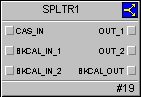
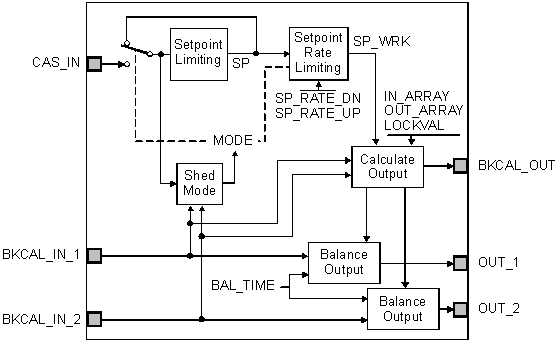
CAS_IN is the remote setpoint from another block.
BKCAL_IN_1 is the value and status reflecting the BKCAL_OUT of the lower block associated with OUT_1. It is used for initialization and to prevent windup in upstream blocks.
BKCAL_IN_2 is the value and status reflecting the BKCAL_OUT of the lower block associated with OUT_2. It is used for initialization and to prevent windup in upstream blocks.
OUT_1 is the first output value and status.
OUT_2 is the second output value and status.
BKCAL_OUT is the value and status required by the BKCAL_IN input of the upstream block to prevent reset windup and to provide bumpless transfer to closed loop control.
The following figure shows the internal components of the Splitter function block: