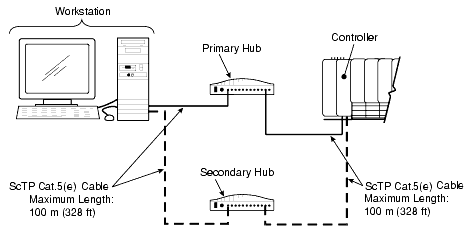
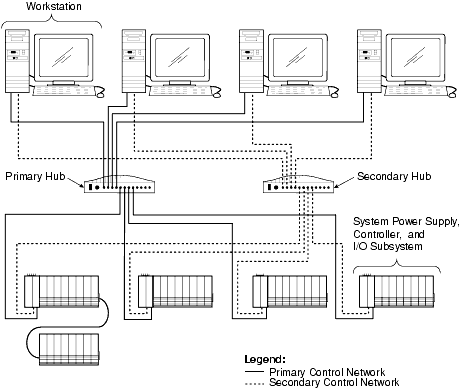
The Control Network is an isolated Ethernet local area network (LAN) that provides communication between the controllers and workstations. It uses standard Ethernet hubs and switches for communications connections. An optional 10Base-T/100Base-TX switch can be added for networks with more than 20 controllers and 32 nodes.
The Control Network is dedicated to the DeltaV system. A separate Ethernet interface is provided via the DeltaV ProfessionalPLUS and Application Station to connect the DeltaV system to a plant-wide LAN. The primary way to connect a plant LAN to the DeltaV system is through either or both the ProfessionalPLUS and Application station. The only way to run non-DeltaV applications (other than Microsoft Excel) is through a DeltaV Application Station.
 CAUTION!
Connecting unapproved non-DeltaV equipment to the DeltaV Control Network can cause unpredictable operation of the system.
The DeltaV Control Network has been designed to be redundant for communications reliability. The Control Network is composed of Primary and Secondary communication channels that are implemented with separate Ethernet NIC cards as well as separate network hubs and switches for each channel.
Care must be taken when designing your network to not have large amounts of network traffic running through the area control network across switches which are also used for control (for example, controllers and CIOCs). Failing to do so can result in the control integrity being compromised causing ACN switchovers and device dropouts.
Standard Category 5(e) Screened Twisted Pair (ScTP) cable must be used for Control Networks with distances of up to 100 meters (328 feet) between Ethernet ports. Refer to “Ethernet Cable Specifications and Installation Rules” for cable specifications. For distances of up 2 kilometers (6562 feet) between Ethernet ports, 19 inch rack-mounted switches with a fiber-optic interface or small form factor switches with fiber-optic ports can be used. Refer to “DeltaV Fiber Switches” for information on a small form factor switch with fiber-optic ports. Be sure to specify the fiber-optic option when ordering the 19 inch rack-mounted switch. Also, fiber-optic communication channels are preferable when:
- Possible electromagnetic noise interference might exist and standard cable does not provide sufficient protection.
- Ground isolation and protection from near lightning strikes are required for building to building communication links.
The following sections contain network diagrams that provide an overview of possible network configurations for DeltaV systems. Refer to Control Network Specifications for detailed installation diagrams and instructions including requirements for Ethernet shield orientations, rules for connecting switches in cascade and star topologies, identification of fiber-optic and twisted pair cable connectors, switch configuration, and other important installation requirements.
If your DeltaV system consists of one workstation and one controller only, you can connect the DeltaV network without using a hub. The cable must be routed directly from the workstation to the controller. Figure: No Hub System Example shows an example of a no hub system. Refer to Control Network Specifications for the cable pinouts in a no hub system.
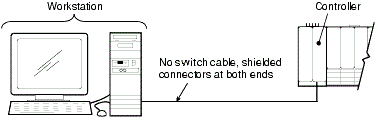
The no-hub cable is for systems with no Control Network Hub. Its wiring is different from that of the standard Ethernet cables used with DeltaV Control Network Hubs.