For both vertically and horizontally mounted systems, the length of the LocalBus, including all cabling is the same; it cannot exceed 6.5 m (21.3 feet). The LocalBus at this length can support eight, 8-wide carriers, one, 4-wide carrier, one, bottom cable extender, and one, top cable extender. However, there is a difference in how maximum length is calculated for Legacy Vertical systems. The following figure shows a standard Legacy Vertical configuration for an eight carrier, 64 card system.
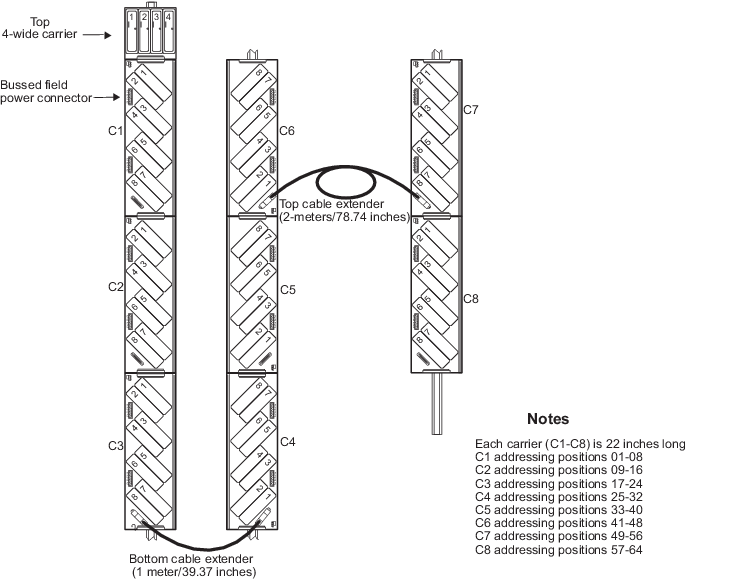
The length to carriers 6 and 7 (C6 and C7) is not counted in the overall length calculation since C6 and C7 are considered spurs and are not in series with the rest of the system. Spur lengths are equal to or less than the total system length.
Refer to preceding figure. There are three carrier ends: 6, 7, and 8. For a vertically mounted system, the signal path starts at the first carrier. The following table shows how to calculate the lengths to the three carrier ends. The cable lengths are 1m. (39.37 in.) or 2m (78.74 in.) and the carrier lengths (C) are 22 inches.
| Total length to the end of carrier: | Calculation |
|---|---|
| 6 | C1 + C2 + C3 + 1m + C4 +C5 + C6 = 14.3 ft |
| 7 | C1 + C2 + C3 + 1m + C4 +C5 + 2m + C7 = 20.8 ft |
| 8 | C1 + C2 + C3 + 1m + C4 +C5 + 2m + C8 = 20.8 ft |
Do not connect additional carriers to spurs as this will corrupt the addressing scheme. Referring to Figure: Standard Configuration for an Eight Carrier Legacy Vertical System, if you connect a carrier to the end of carrier 6, it will become carrier 7. In the addressing scheme shown in the figure, carrier 7 already exists at the end of the 2 meter cable.