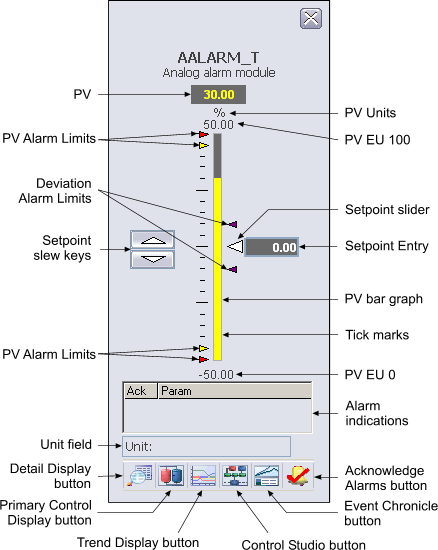
The following items are contained in the faceplate:
-
PV - This field displays the PV value of the loop module in yellow. The background color of the 3-D box changes from gray to orange or red when the PV status becomes uncertain or bad, respectively. The background blinks red when the PV Bad alarm is unacknowledged. The PV value is visible in the decimal format provided by PV_SCALE.DECPT.
-
PV Units - This area provides the engineering units description used for the PV as defined in the PV_SCALE parameter.
-
PV EU 100 - This value corresponds to 100% of scale for the PV.
-
PV Alarm Limits - These arrowheads are vertically positioned relative to the PV bar graph to indicate the High High, High, Low, and Low Low Alarm Limits for the PV. Although these arrows cannot be dragged with the mouse, the values they indicate can be modified by using the module's detail display. Only alarms that are enabled have a corresponding arrowhead displayed. The color corresponds to the alarm priority.
-
Deviation Alarm Limits - These arrowheads are vertically positioned relative to the Setpoint slider to indicate the High and Low SP-PV Deviation Limits. Although these arrows cannot be dragged with the mouse, the values they indicate can be modified using the module's detail display. When the Deviation Limit values are changed from the detail display or Control Studio Online, the faceplate must be reopened for the new positioning to take effect. The deviation alarm must be enabled for these arrowheads to be displayed. The color corresponds to the alarm priority.
-
Setpoint Entry - Setpoint Entry is the 3-D recessed box displaying the SP value of the loop module. The Setpoint Entry box is next to the Setpoint slider. The background color of this box changes from gray to orange or red when the PV status becomes uncertain or bad, respectively. Clicking this box while the target mode is AUTO, MAN, or OOS produces a dialog that prompts you for an SP (Setpoint) value. The valid range for input is defined by the engineering unit EU 0 and EU 100 values of PV_SCALE. Valid input ranges from 0 to 100 percent of PV_SCALE. The SP value is visible in the decimal format provided by PV_SCALE.DECPT.
-
Setpoint slider - To move the Setpoint slider, hold down the left mouse button while the cursor is over the arrowhead and then move the mouse up or down to correspond to the new SP (Setpoint) value desired. The new value is then written to the SP1 parameter of the MPC block. The arrowhead is controllable only when the target mode is AUTO or MAN.
-
Setpoint slew keys - These buttons with an arrowhead pointing up or down are used to increment or decrement the Setpoint value by 1 CNTRL1 engineering unit if CNTRL1_SCALE.F_DECPT is less than or equal to 1. If CNTRL1_SCALE.F_DECPT is 2 or greater, each click changes the Setpoint by 0.1 engineering unit. The Setpoint slew keys are visible if the target mode is AUTO or MAN.
-
PV bar graph - This field indicates the value of the PV parameter for the AI, which is the same as the value displayed in the PV display box.
-
Tick marks - Use this vertical arrangement of black lines to indicate percentages of CNTRL1 and MNPLT1 scale.
-
PV EU 0 - This value corresponds to 0% of scale for the PV.
-
Alarm indications - This is a scrollable list of the current alarms that functions like the first two columns of an alarm summary. The first column shows the state of the alarm represented by one of the following symbols:
The second column is the alarm name or parameter. The text and colors are as configured for the alarm's current state.
-
Unit field - This field displays the unit name.
-
Toolbar - Click the icons from left to right to perform the following functions, respectively:
-
Detail Display button: open the detail display for the loop module.
-
Primary Control Display button: open the primary control display.
-
Trend Display button: open the current trend display for the loop module.
-
Control Studio button: open Control Studio.
-
Event Chronicle button: open the Process History Viewer.
-
Acknowledge Alarms button: acknowledge all alarms on this module.
-
-
Module Error indicator (not shown) - A flashing blue bar is displayed below the Detail Display button when a module error occurs. This prompts you to go to the detail display to view and clear the error.