The Enhanced Device Control (EDC) function block provides setpoint control for multistate discrete devices such as motors, pumps, and block valves. The block compares the requested state (setpoint) to the actual state reported from the device and, after allowing time for the device to change state, detects alarm limits on any error. The basic functionality is augmented by an assortment of interlocks and device control options to customize the block's operation for an application.
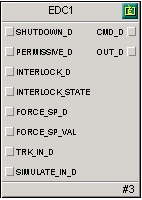
The Enhanced Device Control function block supports mode control, setpoint tracking, simulation, failure analysis (Sentinel and Write Alarm, for example), and alarm limit detection. You can select options that specify the control strategy used in the block.
The setpoint (SP_D) requests that the device go to one of the six supported states: State 0, State 1, State 2, State 3, State 4, and State 5. States 2 through 5 are optional. One of the six states can be defined as the Passive state, which is typically the power failure (safe) state, such as OFF or CLOSED. The other states are the Active states. An Active state usually requires energy (or allows energy to flow), such as OPEN, RUN, FORWARD, or REVERSE. Configure the number of Active states required for the device you are controlling. Configure the set of state names that apply to the device, such as STOP/FORWARD/REVERSE or OFF/LOW/HIGH.
The Enhanced Device Control block uses as many as eight discrete I/O channels to command a device to the requested setpoint state and to read back its confirmation contacts. Discrete I/O is associated with the six states by a mask for each state that allows each bit to be defined as True (1), False (0), or not used. Configure four bits as outputs to the device and four bits as the contacts that confirm the device state. The confirm contacts must be maintained because the block is designed to alarm on loss of confirmation.
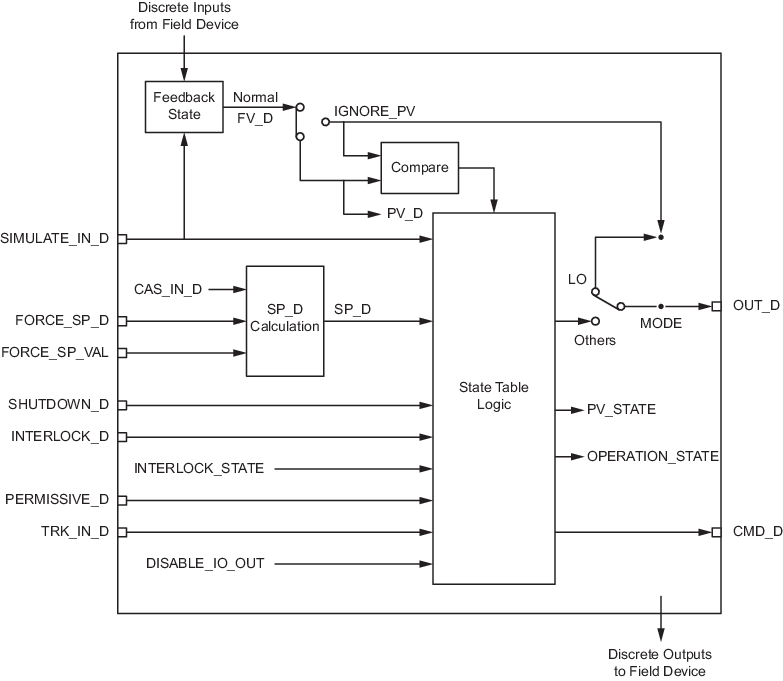
SHUTDOWN_D is the emergency stop discrete value and status input that forces the block to the Passive state and holds it there.
TRK_IN_D is the discrete input value and status that forces the block mode to Local Override and causes the output to follow the field value (FV_D).
SIMULATE_IN_D is the optional discrete input value and status used to simulate the field value.
INTERLOCK_D is the optional discrete input value and status that must be True when the Interlock device option is selected for the device to remain in a state different than the state defined by INTERLOCK_STATE.
The INTERLOCK_STATE value is the state number of the state that interlocks the EDC block when INTERLOCK_D is False. When the value of INTERLOCK_STATE is 255, the EDC block uses the state number corresponding to PASSIVE_STATE.
PERMISSIVE_D is the optional discrete input value and status that must be True when the Permissive device option is selected to allow the device to be commanded to an active state. When the Permissive to Any State device option is selected, permissives apply to any state transition. This includes transitions between active states and transitions into the Passive state.
FORCE_SP_D is the optional discrete input value and status that forces the setpoint (SP_D) to FORCE_SP_VAL in Auto when the device option Force Setpoint in Auto is selected, or that forces the cascade setpoint (CAS_IN_D) to FORCE_SP_VAL in CAS when the device option Force Setpoint in CAS is selected.
FORCE_SP_VAL is the optional discrete input value and status that overwrites the setpoint (SP_D and/or CAS_IN_D) when FORCE_SP_D is transitioning from False to True and the device option Force Setpoint in CAS and/or Force Setpoint in Auto is selected.
OUT_D is the discrete output value and status that reflects the current commanded device state.
Applicable events are recorded in the event chronicle.
The following figure shows a simplified view of the internal components of the Enhanced Device Control function block.