The standard deviation and capability deviation are automatically calculated for the Control and/or Constraint parameters included in the MPC dynamic control. These calculations are based on a moving window equal to the Time to Steady State. The largest calculated standard deviation and its associated capability standard deviation are shown as parameters of the MPCPro block, STDEV and STDEV_CAP. These parameters are used by Inspect with InSight to monitor control variability.
When a Constraint or Control parameter is at or outside its limits or range, its condition is indicated in the OUT_LIMIT_ACT and OUT_EXCEED_ACT parameters. In addition, the percent time this condition was active is indicated in the OUT_LIMIT_POT and OUT_EXCEED_POT parameters. Similarly, the MV_LIMIT_ACT and MV_LIMIT_POT indicate when an MV is at its limit and the percent time it was at its limit. The POT_RESET parameter can be used to reset these percent time calculations. In these limit calculations, a configurable amount of hysteresis is applied to avoid chatter in these limit indications under conditions when the measurement contains significant noise. As shown below, the hysteresis defines the amount that the value must return within its limit or return to the limit before the at limit or exceed limit indication is cleared.

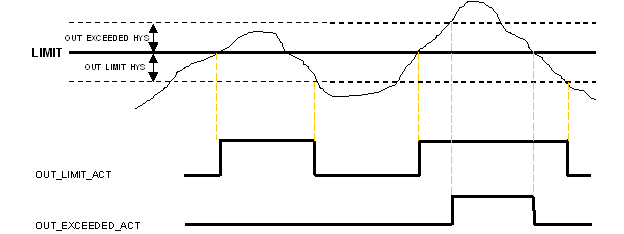
The default hysteresis is 1. If none of these cases occurred then the limit status of PROC_OUTn is propagated thru to OUT_LIM_ACT[] (that is actually the only way the status could be constant). For MVs the limit status of BKCAL_IN is propagated.
Exceeded is never flagged for MVs as it can only occur in OOS mode.
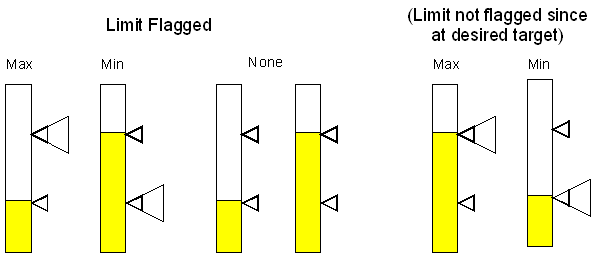
Exceeded is flagged regardless of desired move direction.
The profit associated with the current operation and that which can be achieved is calculated by the MPCPlus block based upon the objective function in use and the cost associated with Manipulated, Control, and Constraint parameters. These values are shown in the Tuning dialog that can be accessed from the MPCOperate Pro application. Also, the MPCPlus block's OPT_PROFIT_CURR and OPT_PROFIT_MAX parameters can be used to include this information in operator displays or to assign it to the Continuous Historian for trending.