The EIOC supports redundant device network connections through its carrier. With redundant networks, the EIOC attempts communications with a device on the device's primary address first. If the primary address fails, it attempts communications on the device's secondary address (must be configured to be a redundant network).
You can use simplex or redundant EIOCs with a redundant device network.
- the redundancy inherent in the device network protocol (the default)
- Parallel Redundancy Protocol (PRP)
Network switchover behavior by communication protocol
Network communications differs based on the EIOC communication protocol.
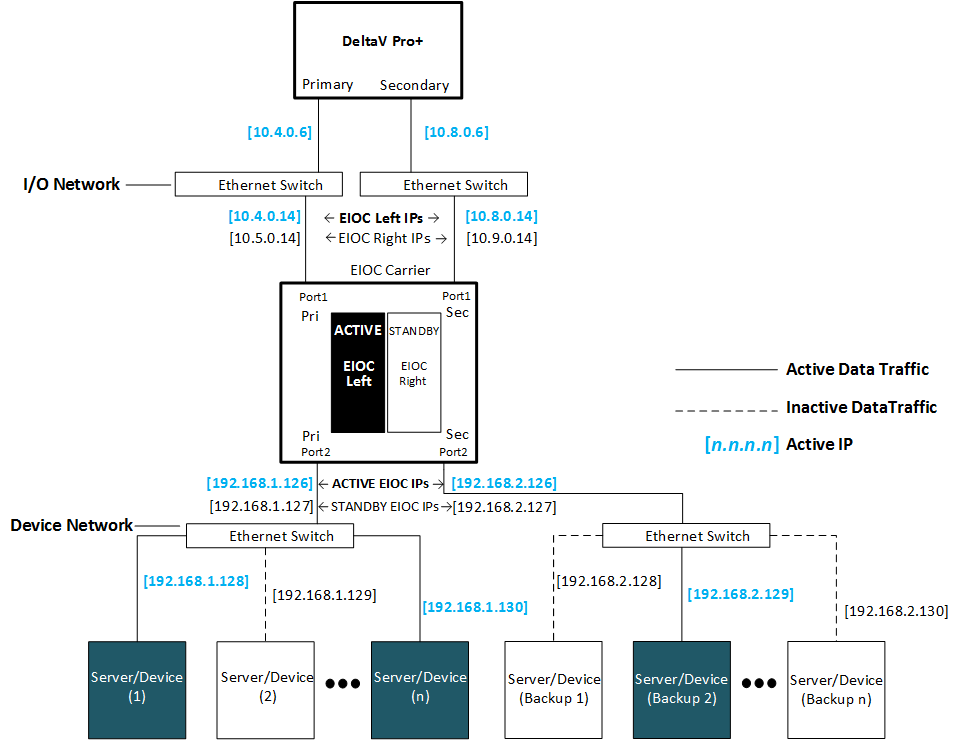
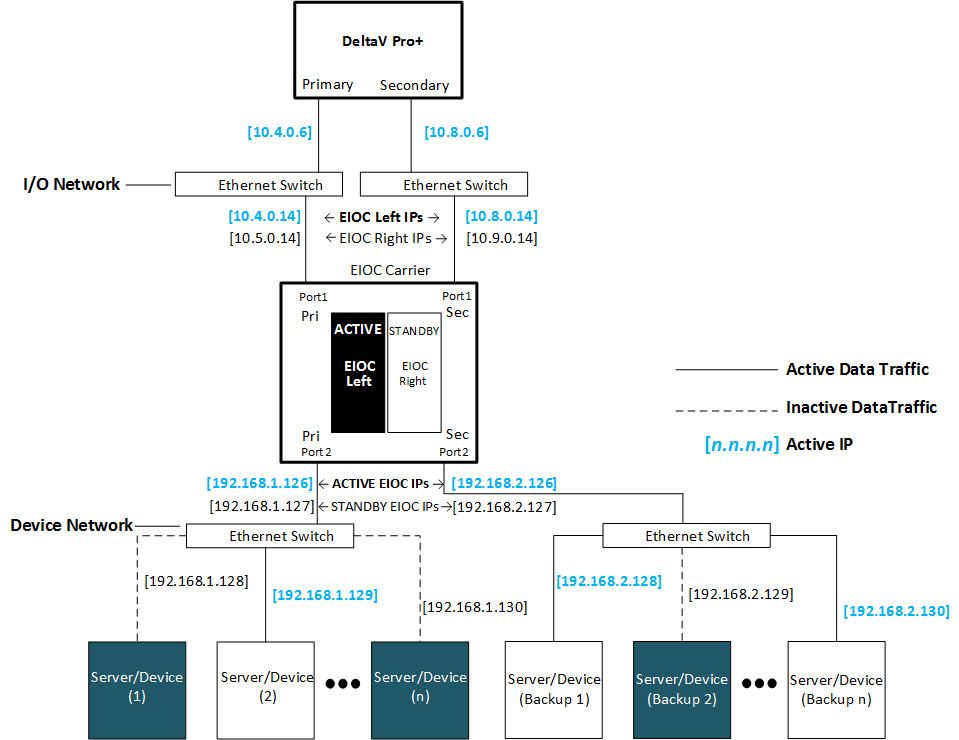
Modbus protocol: The EIOC communicates all data on the primary network while the primary network is available. During this time, the EIOC periodically sends test messages on the secondary network to check the viability of the secondary network. If the primary network becomes unavailable, the EIOC communicates on the secondary. The EIOC switches back the primary network as soon it is available.
Ethernet/IP and Control Tag Integration: The EIOC duplicates communications on both networks but uses data from the active network. If the primary network becomes unavailable, the EIOC uses the secondary network. The EIOC continues to use the secondary (new active) network even when the primary is available again.
OPC UA: The EIOC duplicates sessions on both networks. Active traffic is only on the active network. If the primary network becomes unavailable, the EIOC uses the secondary network. The EIOC continues to use the secondary (new active) network even when the primary is available again. The OPC UA uses up to four sessions with redundant EIOC and redundant networks.
IEC 61850: Refer to the Parallel Redundancy Protocol (PRP) for information on the redundancy behavior of the IEC 61850 protocol.
Network traffic flow diagrams
The following diagrams show how data traffic flows before and after a device network switchover. The diagrams use example IP addresses.
Subnets for redundant device networks
Redundant device networks require that you configure the primary and secondary device networks to be on separate subnets. Additionally, all devices that are connected to the EIOC must have IP addresses that match the subnets of the network to which the devices are connected.
Understanding IP addressing and the subnet mask is key to creating separate subnets. The basic rule is that the sum of the IP address and the subnet mask define the subnets.
IPv4 addresses are grouped into 4 octets, where each octet represents a very large binary number. Depending on the subnet mask, you will need to change the appropriate octet to create the different subnets for your primary and secondary device networks.
For example, if the primary device network is 192.168.1.100 with a subnet mask of 255.255.255.0, you must change the third octet to create a different secondary subnet (192.168.2.101 with a subnet mask of 255.255.255.0).
Contact Emerson support for assistance in designing the device network IP addressing.
Parallel Redundancy Protocol (PRP)
PRP is a high-availability protocol that provides uninterrupted data communication in the event of a device network failure. It does this by duplicating outgoing packets and transmitting them on both device networks. Duplicate communications are discarded by the receiving node. If one network fails, the nodes use the data from the remaining network which is already operational.
You enable PRP on the Ethernet I/O Port Properties dialog (Advanced tab) by selecting the Parallel Redundancy Protocol checkbox. This checkbox is only available during EIOC commissioning.
PRP-enabled devices can connect to both networks. Devices that are not PRP-enabled must connect to a redundancy box (RedBox) before connecting to the network. The RedBox adapts simplex devices for primary and secondary PRP device networks. If you connect a device that is not PRP-enabled to only one network (no RedBox), the DeltaV system generates alarms until a RedBox and a connection to each network is added.