In DP flow applications, the standard deviation is affected by the differential pressure. Thus, if the flow rate increases, the standard deviation also increases. If the flow decreases, the standard deviation decreases. A change in standard deviation caused by a changing flow rate should not be interpreted as an abnormal event.
Field test and laboratory data have shown that for most DP flow applications, the standard deviation is approximately proportionate to the DP mean. This relationship has been observed in a variety of fluids (liquid and gas, for example), primary elements (orifice plate, venturi, flow nozzle, Annubar, and so on) and beta ratios.
The ratio of standard deviation to mean is defined as the Coefficient of Variation (CV).
CV = (StDev/Mean) x 100%
CV will remain approximately constant even if the flow rate changes. Thus, if an operator observes a change in CV, it is much less likely due to a change in the flow rate, and much more likely due to the presence of some abnormal process condition.
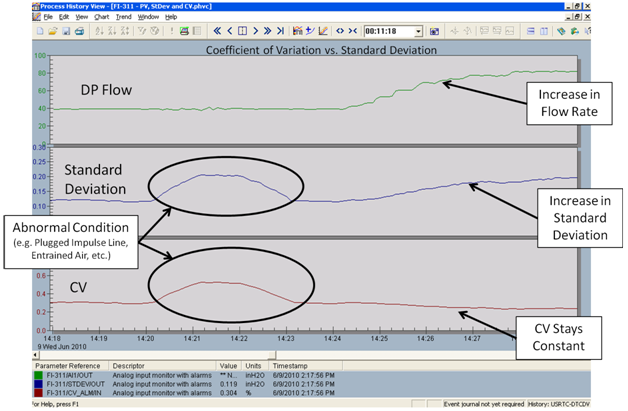
The following figure shows a comparison of standard deviation with CV. During the abnormal event (e.g. plugged impulse line, entrained air, etc.) both the standard deviation and the CV increase. But when the flow rate is increased, the standard deviation increases while the CV stays generally constant.
CV is recommended to be used only with DP flow applications, because for other pressure applications (line, absolute, DP level, and so on) the relationship of standard deviation being proportionate to pressure does not hold.
Note: In the 3051S Advanced HART Diagnostics with DA2 option the Mean, Standard Deviation, and Coefficient of Variation are available directly from the transmitter as HART digital variables. In the 3051S HART DA1 and 3051S FF D01, only Mean and Standard Deviation are available. If needed, CV can be calculated in Control Studio as described in the SPM theory of operation section.