Advanced Pressure Diagnostics technology provides a means for early detection of abnormal situations in a process environment. Advanced Diagnostics technology enables the user to proactively respond to changes in the process, troubleshoot, and prevent loss of production, plant shut-downs or safety hazards.
Virtually all dynamic processes have a unique noise or variation signature when operating normally. Changes in the signatures may signal that an abnormal event has occurred or will occur soon. Examples of abnormal events that are detectable using process variation include plugged impulse lines, furnace flame instability, distillation column flooding, pump cavitation, and entrained gas in liquid flow measurements.
Since pressure measurement applications require a very stable reading, damping is typically applied to both the transmitter and the host system to reduce or eliminate variation. Control systems typically sample the pressure once per second or slower. By the time the pressure measurement reaches the control system most of the noise and variation characteristics have been filtered out, making it difficult or impossible to detect these abnormal process conditions.
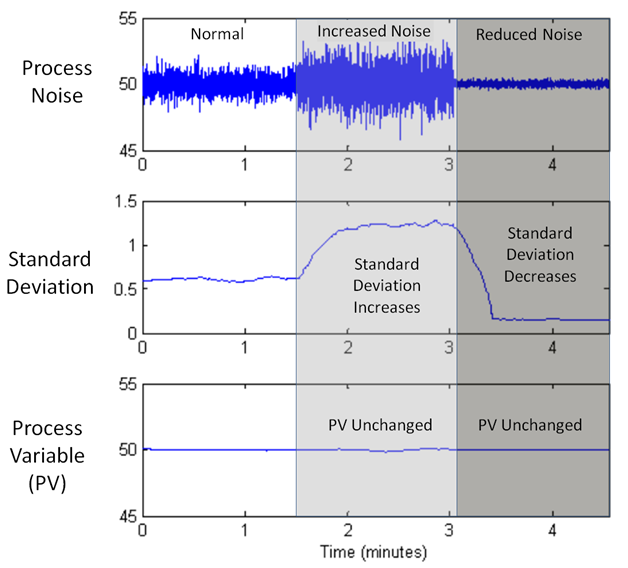
Statistical Process Monitoring (SPM) technology provides a solution by sampling the pressure at a rate faster than available in the control system, computing statistical parameters (e.g. mean, standard deviation, and coefficient of variation), and making these parameters available to a host system via HART or Foundation Fieldbus. The following figure shows one example of how the Standard Deviation value is affected by changes in Process Noise while the Process Variable (PV), as typically seen by the control system, remains unchanged.
The following figure illustrates SPM technology in greater detail. The process pressure is measured by the pressure sensor, and sent to the host system via 4-20 mA. At the same time, a Statistical Calculations Module computes the mean, standard deviation, and coefficient of variation (CV).
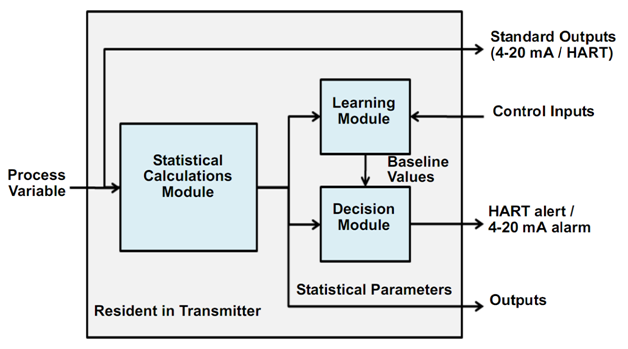
The Statistical Parameters (or SPM variables) are made available as outputs to the host system as HART or Foundation Fieldbus digital variables, where they may be trended in a process historian and viewed by a plant operator. If a process upset occurs, plant staff can look at the process historian and examine the SPM variables to determine if changes in these values gave any prior indication. After understanding how changes in the SPM variables are affected by process conditions a control engineer can create alarms based on the SPM data. The SPM data can also be integrated with plant operations.
As of the DeltaV 12 release, the following pressure transmitters implement Statistical Process Monitoring technology and are compatible with these module templates.
| Manufacturer | Protocol | Device Type | Revision(s) | Description | SPM Variables |
|---|---|---|---|---|---|
| Rosemount | HART | 3051S HDT | 1, 2 | 3051S Advanced HART Diagnostics - DA1 Option | Mean, Std Dev |
| Rosemount | HART | 3051S HDT | 3 | 3051S Advanced HART Diagnostics - DA2 Option | Mean, Std Dev, CV |
| Rosemount | FF | 3051 | 23 | 3051S Foundation Fieldbus with Advanced Diagnostics Suite (D01 Option) | Mean, Std Dev |