Use SISNet Distance Extenders to enable SISNet Repeaters to communicate over distances greater than a few kilometers.
The multimode fiber-optic cable on the SISNet Repeater connects to the SISNet Distance Extender through a conversion cable. The SISNet Repeater end of the conversion cable has an ST male and the SISNet Distance Extender end of the conversion cable has an SC male.
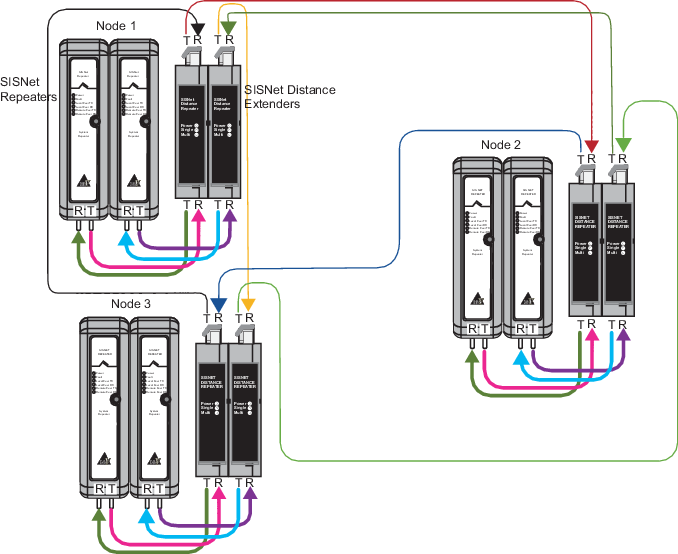
The following figure shows a remote peer ring with two local nodes (Nodes 1 and 3) and one remote node (Node 2) where node refers to a SISNet Repeater pair and SISNet Distance Extender pair. Link distances for a local node are less than or equal to 2 km (nominal) one way. Link distances for a remote node are up to 20 km (nominal) one way. This remote peer ring uses a counter-rotation topology in which the primary SISNet Repeaters are connected clockwise and the secondary counterclockwise. Secure parameters travel from Node 1 to Node 2 via Node 3 on the secondary ring. On the primary ring, parameters travel from Node 2 to Node 1 via Node 3.
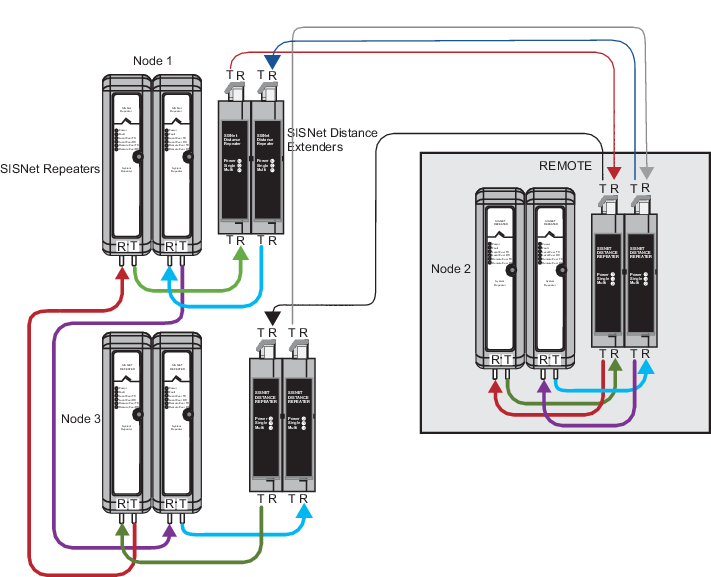
The following figure shows a remote peer ring in which all nodes are remote. Again, node refers to a SISNet Repeater pair and SISNet Distance Extender pair. This remote peer ring uses a counter-rotation topology in which the primary SISNet Repeaters are connected clockwise and the secondary counterclockwise. Secure parameters travel from Node 1 to Node 2 via Node 3 on the primary ring. On the secondary ring, parameters travel from Node 2 to Node 1 via Node 3.