The Local Safety Network Gateway (LSNG) provides a safety integrity level (SIL) 2 link between CSLSs and external Modbus devices.
This section describes the configuration of the LSNG and how to use it to process data received from the Modbus devices. This includes explaining the parts of the configuration that are the same regardless of the Modbus devices that are connected. Other sections explain how to use specific Modbus devices with the LSNG.
The DeltaV system only reads detector data from the Modbus device and does not drive actuators in the Modbus device.
The LSNG communicates with external devices using the Modbus TCP/IP protocol. The LSNG uses the data to form secure parameters and then publish them as global data on the local safety network. If the LSNG is in a DeltaV system that includes Local Safety Network Bridges (LSNB), the data from LSNGs can be used on other LSNs. CSLSs on the network verify and consume from LSNGs in the same way they consume other secure parameter data.
The LSNG operates as a Modbus master with two external devices, one on each port using simplex network connections. The LSNG initiates the Modbus TCP/IP messaging services while the corresponding devices act as Modbus slaves. The LSNG does not support Modbus serial devices behind a Modbus gateway.
After an LSNG is defined in DeltaV Explorer, signals, Modbus ports, and other device-specific items can be configured.
The LSNG topology is shown in the following figure. The GSN and the remainder of the DeltaV system are not shown for clarity.
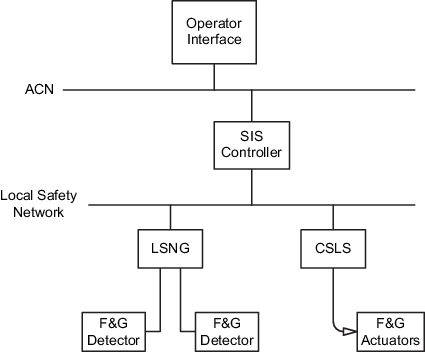
Each Local Safety Network can have as many as four LSNGs (Three if the LSN contains an LSNB). In DeltaV Explorer LSNGs appear under SIS controllers on the LSN. The following figure shows how an LSNG appears in DeltaV Explorer.
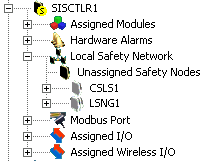
The LSNG is based on the LSNB and uses the same hardware. You can create LSNB and LSNG placeholders and assign LSNB hardware to either. An unassigned LSNB assigned to an LSN under a SIS Controller can be defined as either an LSNB or an LSNG from the LSNB placeholder properties dialog.
LSNG Secure Parameters are mapped into publishers when their corresponding Signals are created in the LSNG configuration. Referencing them does not affect their mapping.
The database maps the secure parameters for each publisher automatically to optimize publisher usage, however, it does not shift existing secure parameter mapping when one or more are deleted. This is to avoid forcing a re-download of referencing logic solvers for unchanged secure parameters.