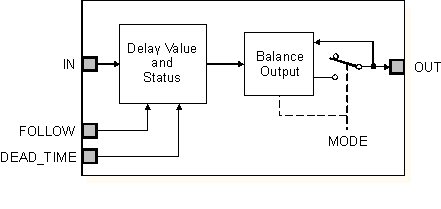
The Deadtime function block introduces a pure time delay in the value and status used in a signal path between two function blocks. The amount of delay introduced is determined by the DEAD_TIME parameter. You set DEAD_TIME manually or allow another function block that is calculating the desired delay to set the value automatically.
In Automatic (Auto) mode, the delayed input value and status are usually set to the block output (OUT). However, when the FOLLOW discrete input is active (FOLLOW = True), the block introduces no delay. A bias is added to the delayed input value to allow bumpless transfer for the transition from Manual (Man) to Auto mode. The bias is ramped to zero over the time specified by BAL_TIME.
The Deadtime function block supports signal status propagation and mode control. The actual mode calculation is based on the input status, target mode, and status handling options for the block.
There are no standard alarms in this function block. Custom alarms are supported.
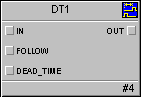
IN is the analog input value and status.
FOLLOW allows OUT to track IN.
DEAD_TIME is the delay time introduced in the input value, in seconds.
OUT is the analog output value and status.
The following diagram shows the internal components of the Deadtime function block: