EIOC nodes can be configured for redundancy. In many circumstances, switchovers occur with no bumps in device data values or status. Redundant EIOC nodes operate as an Active/Standby pair. The active EIOC configures and updates the standby to keep it synchronized with the active. You can use redundant EIOC nodes with simplex or redundant device networks. The standby EIOC in a redundant pair monitors the health of the active EIOC and it becomes the active when:
- The active EIOC fails to communicate with the standby over the redundancy link
- The active EIOC fails to communicate with all configured Ethernet devices
Redundant EIOC nodes are two paired EIOCs, on the same carrier, having either a simplex device network or redundant device networks.
With redundant EIOC nodes, if the active node fails the pair can switchover to the standby for communication to the devices. Once switched over to the standby, if the formerly active node is still not communicating, the pair operates in a simplex EIOC mode.
In the event of one of the switchover conditions shown in the bulleted list above, the EIOC maintains the last values and status. When the standby takes over as the active EIOC, it operates using the last values if it can establish communication with the devices. If the EIOC cannot establish communications, the values go to zero and status is set to BAD.
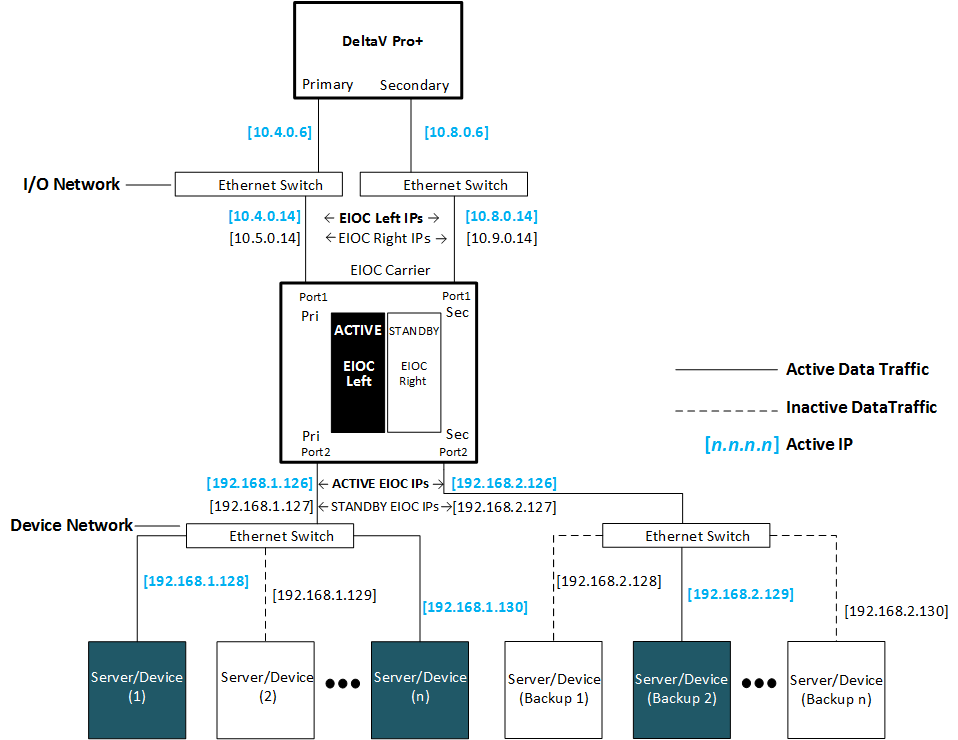
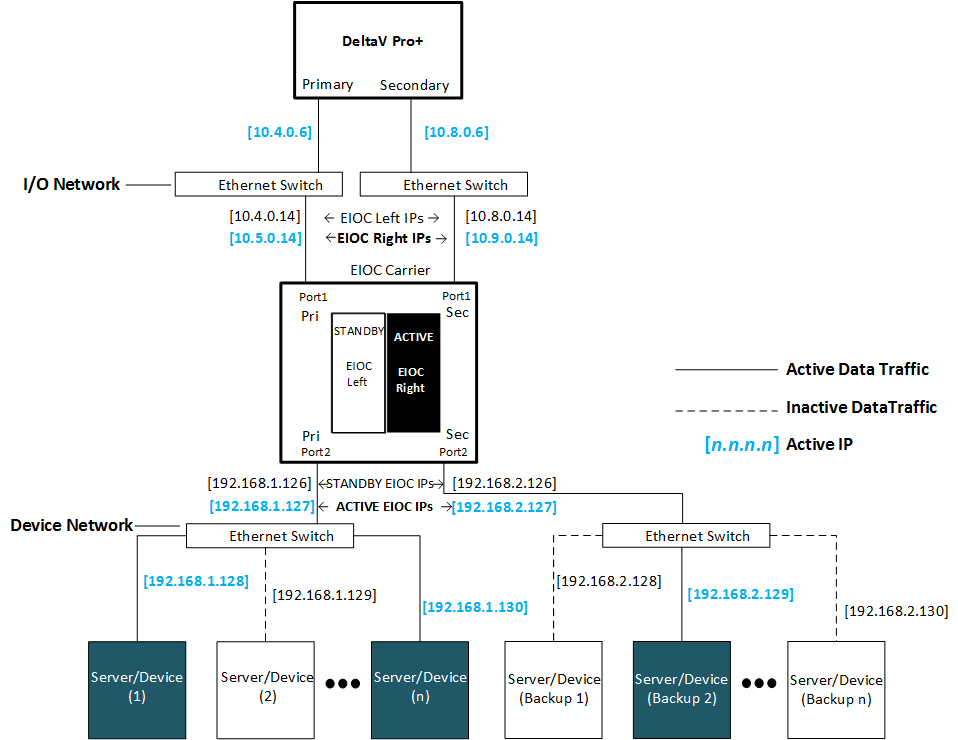
When creating physical devices on redundant EIOCs, be aware that the system assigns the primary and secondary IP addresses of the standby by adding 1 to the configured address. For instance, when the EIOC primary port has a network IP address of 192.168.1.1; the standby EIOC primary port is assigned the primary network IP address of 192.168.1.2.
The following diagrams show how data traffic flows before and after an EIOC device node switchover. The diagrams use example IP addresses.
Configuration considerations
Redundant EIOC nodes can impact your configuration planning. For example, OPC UA redundant installations use more sessions and tags. Refer to related information on DeltaV OPC UA.
Switchover time is the time it takes for control of devices to pass from one EIOC to the other in a redundant pair. Switchover time depends on the communication protocol, the number of connected devices (PDTs in the DeltaV hierarchy), and the number of LDTs and signals configured for the connected devices.
If the EIOC is using either of the supported EtherNet/IP protocols for control, devices must be configured to delay going into fail-safe state after detecting a communication loss. The delay time must be greater than the switchover time for the EIOC. Otherwise, devices will go into the fail-safe state whenever control passes from one EIOC to the other in the redundant pair.