When a CIOC is added to the I/O Network, a collapsed container called CHARMs appears under the CIOC in the Explorer hierarchy as shown in the following image.
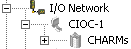
CHARMs can be thought of as single I/O channels under a CIOC that processes the CHARMs' signals and communications. When the CHARMs container is expanded, all 96 CHARMs that can be supported by the CIOC are visible. The 96 CHARMs are organized in eight banks of 12 CHARMs under the CIOC: bank one is CHM1-01 through CHM1-12, bank 2 is CHM2-01 through CHM2-12, bank 3 is CHM3-01 through CHM3-12, and so on. In the hardware, each bank of 12 CHARMs is installed on a carrier called a CHARM Baseplate. The CHARM Baseplate consists of 12 I/O channels with terminals for connecting field wiring and an Address Plug. Each channel is undefined until a CHARM is inserted into that terminal. That is, the installation of the CHARM defines the physical channel type and makes the signal available to the DeltaV system over the redundant bus. In the software, CHARM placeholders are defined according to class and type and then assigned to controllers.The CHARM placeholders can be defined offline or when the CIOC is autosensed.
For information on Logic Solver CHARMs (LS CHARMs) refer to CHARMs Smart Logic Solver (CSLS) SIS Systems in the DeltaV Safety Instrumented System manual in Books Online.