In CSLS safety installations consisting of more than one local safety
network (LSN) it may be necessary for a CSLS to access information on another
LSN. The GSN provides this capability. Local safety network bridges (LSNBs) are
the hardware items that are connected to create the GSN.
The following table lists terms and acronyms used to describe CSLS
global safety network components.
Table: Terms and acronyms
| Term
|
Meaning
|
| LSN
|
Local Safety Network
A collection of GSN nodes, organized in one or more domains.
|
|
LSNB
|
Local Safety Network Bridge
An LSNB is part of the LSN under a SIS Controller. An LSNB
collects user-configured secure parameters from the CSLSs on the LSN it is
connected to, and may publish them on the GSN. LSNBs also receive data from
other LSNBs on the GSN. When an LSNB receives data from the GSN, that data is
made available to CSLSs on its LSN.
Each LSNB can host a maximum of 4 publishers. Each publisher in
an LSNB can publish up to 192 Boolean secure parameters and 64 non-Boolean
secure parameters. There can be a mix of domain and system publishers on the
same LSNB.
The LSNB is available only as a redundant pair.
|
|
GSN
|
Global Safety Network
The GSN is the network of connected LSNBs.
|
|
Domain (GSN)
|
A GSN domain is a set
of LSNs that are
logically grouped in the GSN to share secure
parameters via domain publishers. (Data can also be shared between domains via
system publishers.)
The more domains there are, the more data can be shared.
However, it is recommended to keep the number of domains to the minimum needed
to publish the secure parameters needed, to avoid possible performance issues
during configuration.
DeltaV supports a maximum of 16 GSN domains.
|
|
Publisher
|
Publishers are logical entities in the DeltaV database that
allow data to be shared between LSNs. Publishers are not configured explicitly;
they are automatically created and managed by the system.
As secure parameters within an LSN are referenced by other LSNs, the publisher
creates and populates maps of secure parameters and references. The maps can be
viewed through DeltaV Explorer.
There are two types of publishers:
- A Domain publisher
maps secure parameter references within a specific domain Those references are
referenced by, and are published only to, nodes within the same domain.
- A System publisher
maps secure parameter references that cross domain boundaries. It can publish
secure parameters to nodes both inside and outside the domain that contains
that publisher.
The type of publisher is determined by how you reference a
secure parameter. If you reference a secure parameter on a node in a different
domain (across a domain boundary), the publisher that maps that secure
parameter will be a system publisher.
A secure parameter can only be associated with one publisher.
|
|
Safety system
|
In the context of CSLSs,
safety system is shorthand for the CSLS safety system: the
collection of all SIS controllers and CSLSs and other hardware and software.
|
The following table lists the capacities (limits) for GSN components.
Table: Global Safety Network capacities
| CSLS Global Safety Network property
|
Limit
|
|
LSNB nodes per LSN
|
1
|
|
Domain
publishers per domain
|
16
|
|
Publishers per LSNB (either
type - there can be a mix of domain publishers and system publishers)
|
4
|
|
System publishers per DeltaV system
|
8
|
|
Listener LSNBs per domain
|
No limit
|
|
Boolean Secure parameters per publisher
|
192
|
|
Non-Boolean Secure parameters per publisher
|
64
|
|
Boolean Secure parameters received from the LSN per LSNB
|
768
|
|
Non-Boolean Secure parameters received from the LSN per LSNB
|
256
|
|
Boolean Secure parameters an LSNB can receive from the GSN
|
3072
|
|
Non-Boolean Secure parameters an LSNB can receive from the GSN
|
1024
|
| GSN Domains per system
|
16
|
The following figure shows how the GSN fits in a CSLS system.
Figure: Global Safety Network in a CSLS system
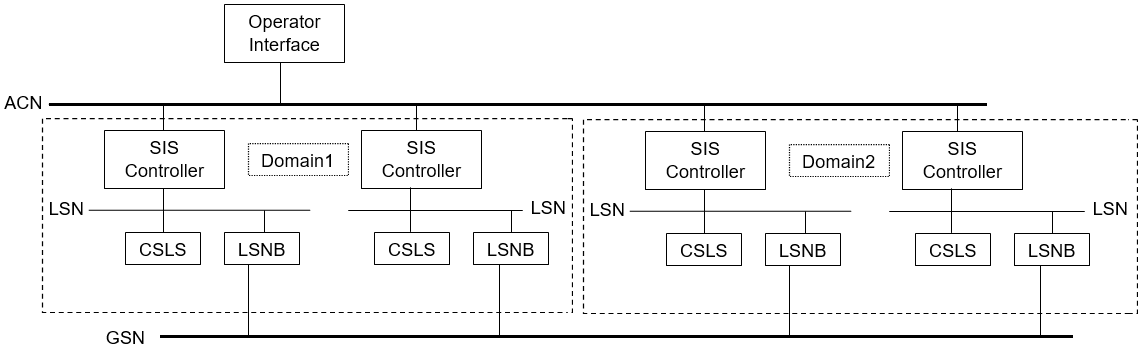
Each LSN only supports one LSNB. The LSNB collects and publishes data
from CSLSs on that LSN. (CSLSs do not all have their data published globally;
there may be some that do, and others that send data only to other CSLSs on the
same LSN.)
The LSNBs are linked on the GSN. In DeltaV Explorer, LSNBs appear in the
hierarchy under SIS controllers on the LSN, and under their assigned domains in
the GSN. The following figure shows how an LSNB appears in DeltaV Explorer.
Figure: Local Safety Network Bridge in DeltaV Explorer
